Building America’s Reliable DC Fast-Charging Future
Furst Charge exists to help put the United States back in front of the clean-energy transition by building reliable, scalable, commercial EV-charging infrastructure.
Why America Must Lead. The Infrastructure Gap. Our Commitment. Build It Here. Operate It Here. Lead From Here. Sources and Methodology
Mission Statement
Veteran-Owned. Built to Deliver.
Furst Charge is a veteran-owned EV charging infrastructure company built on the values of service, accountability, readiness, and disciplined execution. We believe America’s clean-energy future must be practical, reliable, and built to last.
Those values shape how we approach every project—from site feasibility, electrical planning, utility coordination, and funding analysis to installation, network operations, maintenance, and customer support. Our mission is to help businesses, property owners, fleets, municipalities, and communities deploy dependable EV charging infrastructure that supports real-world mobility and a stronger American energy future.
Furst Charge exists to put the United States back in front of the clean energy transition and not chasing someone else's timeline but setting the pace the rest of the world measures itself against. We believe American leadership in this transition isn't optional or symbolic; it's a responsibility that comes with the industrial capacity, research strength, and market size this country already has. Our mission is to make the case, plainly and with the numbers, for finishing what's been started, building infrastructure at the scale the moment demands, and giving the next generation a cleaner, more energy-secure country to inherit.
Current Standing Where the global electric vehicle race stands in 2026 — and the case for an American first charge.
The world is switching to electric faster than the United States is building the plugs for it. China leads on volume, Europe leads on regulation, and emerging markets are moving faster than either. The infrastructure race — not just the vehicle race — is where the next decade of leadership gets decided.
27% of all new cars sold worldwide in 2026 will be electric, up from 9% five years ago.
Three markets, three speeds Share of new car sales that are electric, 2026 estimates
China — 63% Europe — 28% United States — 10%
China's dominance is now backed by price, not just policy — nearly 70% of battery-electric cars sold there in 2025 undercut the equivalent gas model before incentives. Europe is climbing on the strength of tightened CO2 standards, with Norway effectively finished: 97.6% of December 2025 new-car sales were battery-electric. The U.S. is moving the opposite direction, with federal tax credits expired and a projected 19% sales decline in 2026.
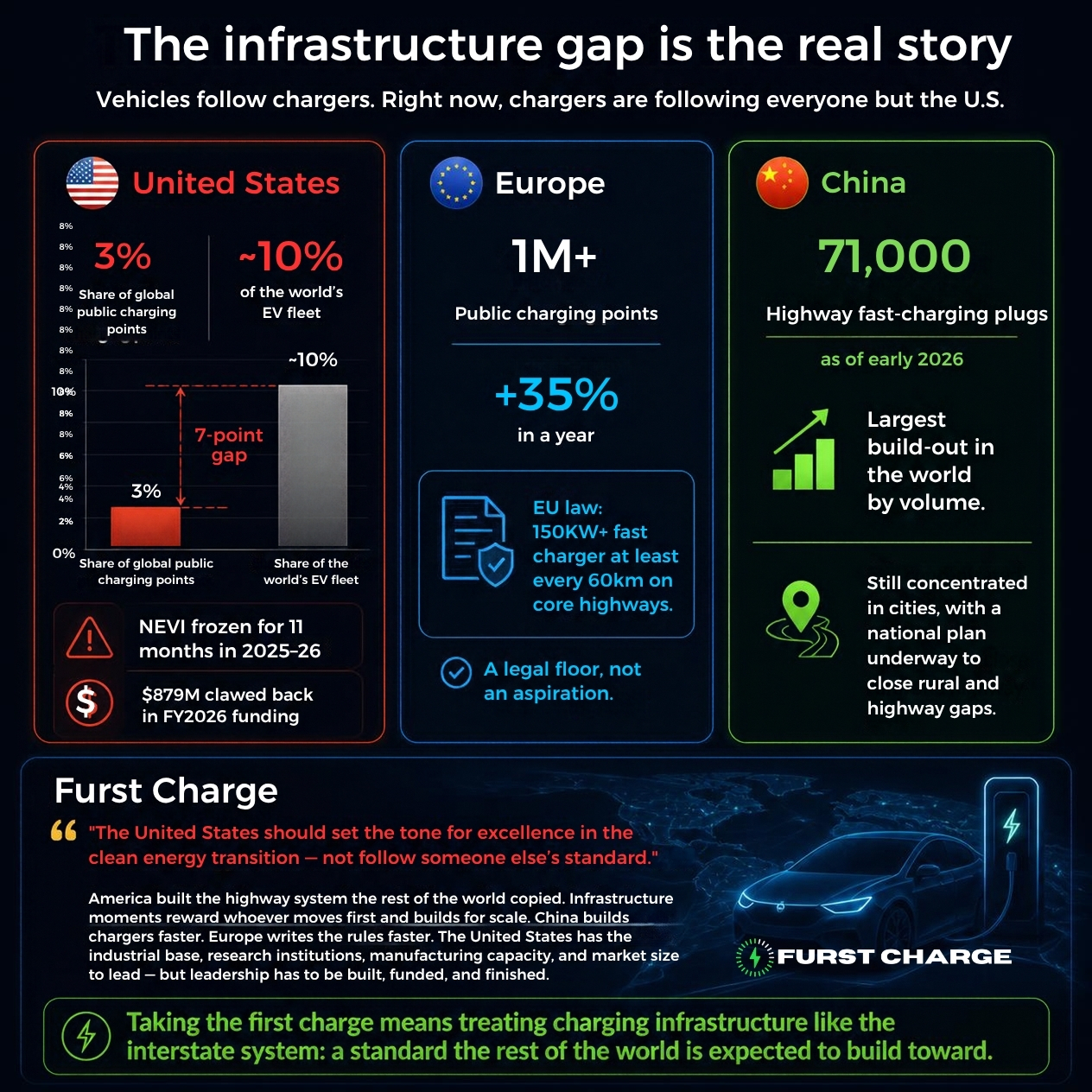
The infrastructure gap is the real story Vehicles follow chargers. Right now, chargers are following everyone but the U.S.
United States — 3% Share of global public charging points — against roughly 10% of the world's EV fleet. The federal NEVI program was frozen for eleven months in 2025–26, and Congress clawed back $879M in FY2026 funding.
Europe — 1M+ Public charging points, up more than 35% in a year. EU law now mandates a 150kW+ fast charger at least every 60km on core highways — a legal floor, not an aspiration.
China — 71,000 Highway fast-charging plugs as of early 2026, the largest build-out in the world by volume — though still concentrated in cities, with a national plan underway to close rural and highway gaps.
Furst Charge
The United States should set the tone for excellence in the clean energy transition — not follow someone else's standard.
America built the highway system the rest of the world copied. It strung a gas station across every stretch of interstate before most countries had finished paving their roads. It turned the assembly line into a global export. Infrastructure moments like this one reward whoever moves first and builds for scale — not whoever waits to see how the market shakes out.
Right now, that first move belongs to someone else.
China builds chargers faster. Europe writes the rules faster. The United States has the industrial base, the research institutions, the manufacturing capacity, and the market size to lead this transition outright — but leadership has to be built, funded, and finished, not paused and restarted every time a budget cycle turns over.
Taking the first charge means treating charging infrastructure the way the country once treated the interstate system: as a standard the rest of the world is expected to build toward, not a line item that competes for survival every year. It means finishing what's funded, setting the technical bar other countries measure themselves against, and building a network reliable enough that range anxiety stops being part of the American vocabulary.
The reward isn't just market share. It's a more resilient grid, cleaner air in the cities where most Americans live, and a credible answer when the rest of the world asks who actually set the standard for what a clean, sustainable energy economy looks like.
That standard should be set here — for the country, and for the world that follows it.
Proudly Veteran-Owned | Commercial EV Charging Infrastructure
Sources:
International Energy Agency, Global EV Outlook 2026 — https://www.iea.org/reports/global-ev-outlook-2026/executive-summary
International Energy Agency, Global EV Outlook 2026 — Charging — https://www.iea.org/reports/global-ev-outlook-2026/electric-vehicle-charging-chap-6-and-10
BloombergNEF, Electric Vehicle Outlook 2026 (via Design News) — https://www.designnews.com/automotive-engineering/global-ev-sales-to-hit-27-of-market-in-2026-despite-us-policy-headwinds-bloombergnef-reports
BloombergNEF, Electric Vehicle Outlook 2026 (via Battery-Tech Network) — https://battery-tech.net/battery-markets-news/global-ev-sales-to-top-23m-in-2026-china-dominates-market/
Congressional Research Service, Status of Federal Implementation of EV Charging Infrastructure — https://www.congress.gov/crs-product/IN12556
ACT News, The United States of NEVI — https://www.act-news.com/news/the-united-states-of-nevi/
Axis Intelligence, EV Adoption Statistics 2026 — https://axis-intelligence.com/ev-adoption-statistics/
Figures are 2026 estimates and are subject to revision as full-year data is finalized.