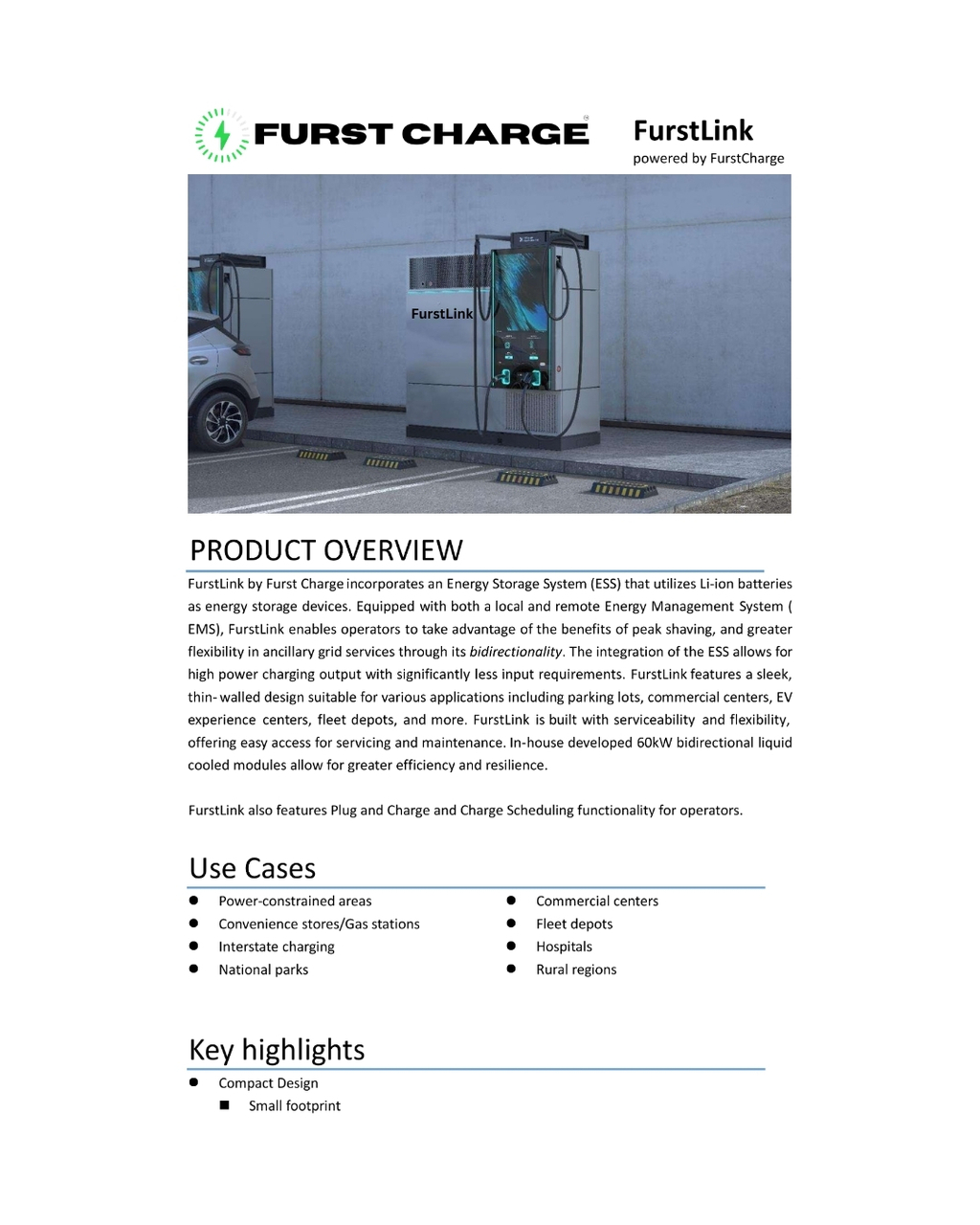
FURSTLINK DC Fast Charging System
Fast charging, battery storage, and solar-ready energy management in one commercial solution.
FURSTLINK is a commercial Level 3 DC fast-charging system designed for properties that need to deliver meaningful EV charging during shorter visits while helping manage the energy challenges that come with high-power charging.
Unlike a conventional charger-only deployment, FURSTLINK combines DC fast charging with integrated battery energy storage and a solar-ready design. This gives qualified commercial properties a more flexible way to evaluate EV charging, grid capacity, demand charges, energy storage, and on-site solar as one coordinated infrastructure strategy.
Furst Charge helps property owners determine whether FURSTLINK is right for their site before they invest. We evaluate electrical capacity, utility rates, demand charges, charging demand, parking layout, battery strategy, solar potential, available incentives, installation requirements, and long-term project economics.
[Request FURSTLINK Pricing]
[Request a Site Feasibility Review]
Actual charging speed, battery operation, solar production, and utility-cost impact depend on the final system configuration, vehicle demand, battery condition, electrical capacity, utility tariff, weather, site load, and operating conditions.
Why choose FURSTLINK?
DC fast charging for real commercial demand
FURSTLINK is built for properties where drivers need more than overnight or all-day charging. It is designed to support meaningful charging while customers shop, dine, attend appointments, stay at a hotel, visit a destination, operate a fleet vehicle, or make a scheduled stop.
It may be a strong fit for:
- Supermarkets and grocery stores
- Retail centers and shopping destinations
- Restaurants, cafés, and convenience-oriented locations
- Hotels, hospitality properties, and visitor destinations
- Medical offices, clinics, and service locations
- Municipal and community properties
- Public-facing parking areas
- Travel-oriented commercial sites
- Fleet and business vehicle operations
- Properties where drivers typically remain for 20 to 30 minutes or longer
DC fast charging may help drivers add meaningful range during a shorter visit, depending on the vehicle’s charging capability, battery condition, charger configuration, and available power.
Integrated battery storage to help manage peak demand
High-power EV charging can create short periods of significant electrical demand. Depending on the utility tariff, those peaks can increase operating costs through demand charges or may require major electrical upgrades before a charging project can move forward.
FURSTLINK’s integrated battery energy storage can help supplement available grid power during high-demand charging events. Instead of relying only on the grid for the full charging load at every moment, the system can use stored energy as part of the site’s overall energy-management strategy.
Depending on the final design and site conditions, this may help a property:
- Manage peak grid demand during DC fast-charging sessions
- Reduce exposure to demand-charge spikes
- Support fast charging where utility capacity is limited
- Create a more flexible path to deployment
- Reduce or defer certain infrastructure upgrades where appropriate
- Improve the use of available electrical capacity
- Support future charging expansion
- Coordinate charging demand with the property’s broader energy needs
Battery storage does not eliminate electricity costs or guarantee demand-charge savings. Results depend on the site load profile, utility rate structure, battery configuration, charging demand, energy-management strategy, and operating conditions.
Solar-ready design for a broader energy strategy
FURSTLINK can be designed to incorporate solar panels as part of a complete site-energy plan.
Solar generation may help support EV charging, battery charging, or other on-site electrical needs when production is available. For properties with suitable roof area, parking-canopy space, or other solar-development potential, FURSTLINK creates an opportunity to combine EV charging, battery storage, and solar in one coordinated project.
Potential benefits of solar integration may include:
- Supporting on-site renewable-energy and sustainability goals
- Offsetting a portion of site electricity consumption
- Providing energy that may be used by the charging system or stored in the battery
- Improving long-term energy-management flexibility
- Supporting ESG, electrification, and sustainability reporting
- Creating a visible clean-energy amenity for customers, tenants, employees, and visitors
- Preparing the property for future energy-resilience strategies
Solar production varies by weather, season, system size, site shading, orientation, utility rules, and final design. Solar is not a substitute for grid power during every charging session, but integrated battery storage can help manage available energy as part of the site’s operating strategy.
How FURSTLINK works
FURSTLINK combines three core components into a coordinated commercial energy solution:
1. DC fast charging
The system provides Level 3 DC fast charging for compatible electric vehicles. DC charging delivers power directly to the vehicle battery, enabling a substantially faster charging experience than Level 2 charging in appropriate commercial applications.
2. Battery energy storage
Integrated battery storage can store energy and supplement the grid during high-demand charging periods. This may help the site manage peak-power requirements, support fast-charging demand, and create greater flexibility where electrical capacity is constrained.
3. Solar-ready integration
Where solar is included in the project design, on-site solar generation may support the charging system, battery charging, or other property energy needs when solar production is available.
The final energy-management approach is designed around the property’s electrical capacity, utility rates, site load, charging demand, solar potential, battery configuration, and operating goals.
Built for commercial properties
Supermarkets and grocery stores
FURSTLINK can help supermarkets offer a convenient charging amenity for drivers who want to add range while shopping. Grocery stores can be attractive charging locations because customers often make repeat visits and may remain on-site long enough to benefit from DC fast charging.
The strongest projects combine public access, good site visibility, convenient entry and exit, reliable parking, local EV demand, an electrical or utility-upgrade path, and realistic project economics.
Retail and destination properties
Retail centers, shopping destinations, restaurants, entertainment venues, and other customer-facing businesses can use FURSTLINK to make EV charging part of the visitor experience.
Charging may help drivers choose your location, remain on site while their vehicle charges, and return for future visits. Results depend on utilization, local demand, pricing, competition, electricity costs, and the operating model.
Hospitality and travel-oriented sites
Hotels, lodging properties, visitor destinations, and travel-oriented businesses can provide a convenient fast-charging option for guests and travelers who need charging during a stop or stay.
Medical and service destinations
Medical offices, clinics, service businesses, and appointment-based destinations may be strong candidates where customers commonly remain for 20 to 30 minutes or longer.
Municipal and community locations
Municipal facilities, public parking areas, libraries, community destinations, faith-based organizations, and other public-access properties can explore FURSTLINK to expand charging access for visitors, employees, municipal vehicles, and the public.
Fleet and commercial operations
FURSTLINK may support commercial fleets that need faster charging during planned operational windows, route stops, shift changes, or depot activity. Furst Charge evaluates vehicle type, daily mileage, charging windows, electrical capacity, operating costs, and future fleet growth before recommending a system design.
Designed around your site
A successful DC fast-charging project requires more than a charger. Before recommending FURSTLINK, Furst Charge evaluates the complete property and energy profile.
Our feasibility review may include:
- Existing electrical service, transformer capacity, panels, switchgear, and available power
- Existing building load and peak-load behavior
- Utility service, rate structure, time-of-use periods, and demand-charge exposure
- Battery energy-storage strategy and energy-management controls
- Solar roof, canopy, or ground-mount potential
- Utility interconnection and solar-permitting requirements
- Parking layout, charger placement, cable reach, traffic flow, and accessibility
- Public access, site visibility, driver amenities, and anticipated utilization
- Trenching, conduit, concrete, bollards, signage, and civil construction needs
- Charger access, pricing, payment, fleet controls, and driver experience
- Potential utility make-ready programs, rebates, grants, tax incentives, or other funding opportunities
- Phased deployment and future expansion plans
- Monitoring, maintenance, operational support, and long-term asset management
A limited electrical service does not automatically prevent a site from pursuing DC fast charging. FURSTLINK may allow qualified sites to evaluate a blended approach using available grid power, battery storage, solar integration, load management, utility upgrades, or phased construction.
What Furst Charge provides
Furst Charge supports the full project—not simply equipment procurement.
Our team can help with:
- Commercial site feasibility assessments
- Electrical and utility-capacity review
- Utility-rate and demand-charge analysis
- DC fast-charger selection and configuration planning
- Battery energy-storage evaluation
- Solar-readiness and on-site renewable-energy assessment
- Site-energy and load-management strategy
- Project budget and preliminary financial analysis
- Utility coordination and infrastructure planning
- Incentive and funding opportunity review
- Equipment sourcing and logistics
- Installation coordination
- Commissioning and network activation
- Pricing, payment, and driver-access setup
- Remote monitoring and operational support
- Maintenance coordination and long-term expansion planning
Is FURSTLINK right for your property?
FURSTLINK may be a strong option for properties that want DC fast charging but also need to evaluate grid capacity, demand charges, battery storage, solar potential, and long-term operating costs.
It may be particularly valuable for public-facing destinations, fleets, supermarkets, retail locations, hospitality properties, municipal sites, and other commercial properties with EV-driver demand and typical dwell times of approximately 20 to 30 minutes or longer.
The first step is a site feasibility review. Furst Charge will help you understand what your property can support, what infrastructure may be required, whether battery storage and solar make sense, and which deployment path best fits your business objectives.
[Request FURSTLINK Pricing]
[Request a Site Feasibility Review]
Call or text: 1-855-GO-FURST
Email: info@furstcharge.com
Important product note
*FURSTLINK availability, charging power, battery-storage configuration, solar integration, connector options, payment and network features, warranty terms, installation requirements, and lead times depend on the final system design and applicable project conditions. Actual charging speed, battery performance, solar production, grid-demand impact, demand-charge impact, utility requirements, interconnection, incentive eligibility, project cost, charging utilization, revenue, and financial results vary by site and are not guaranteed.